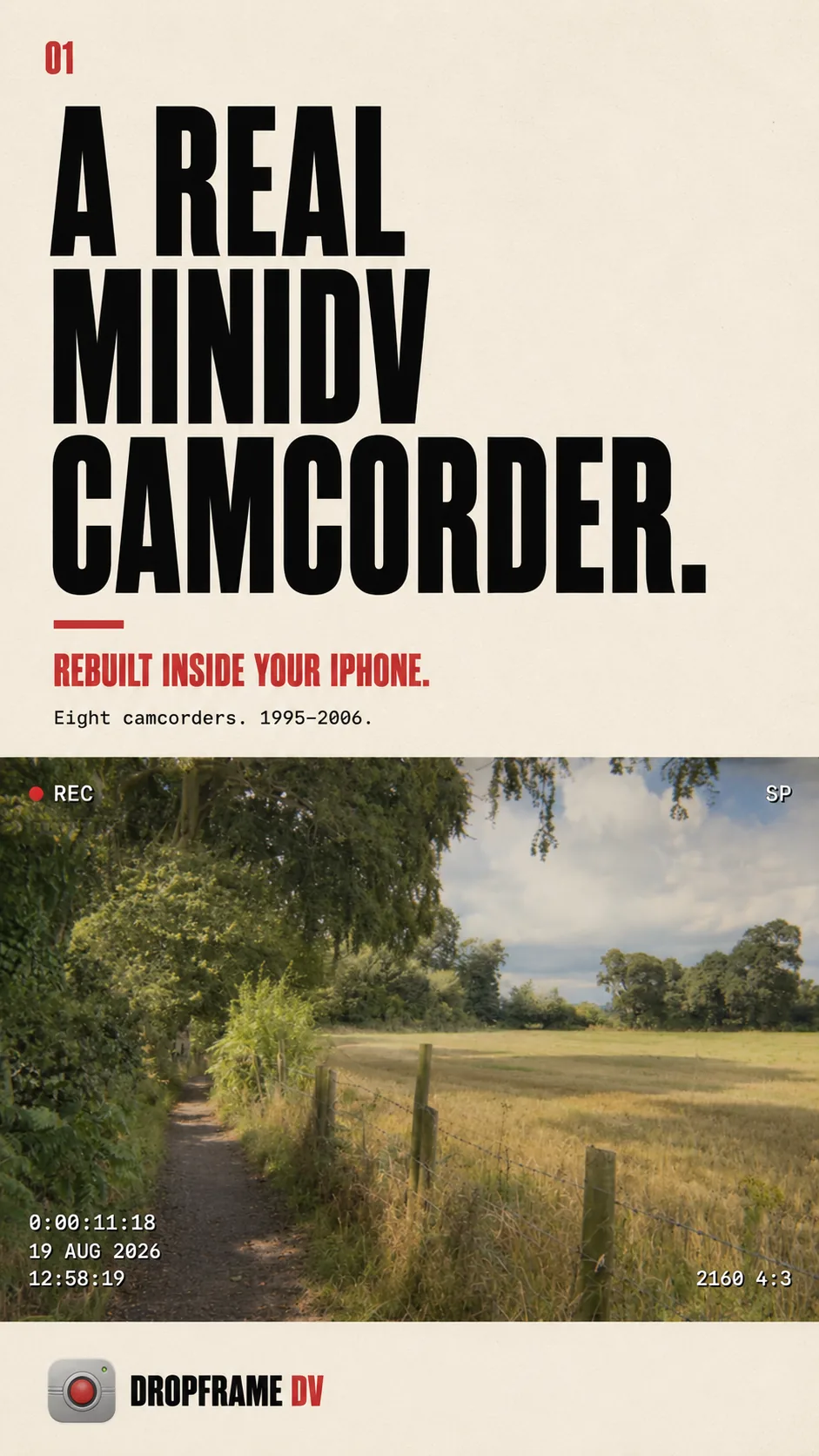
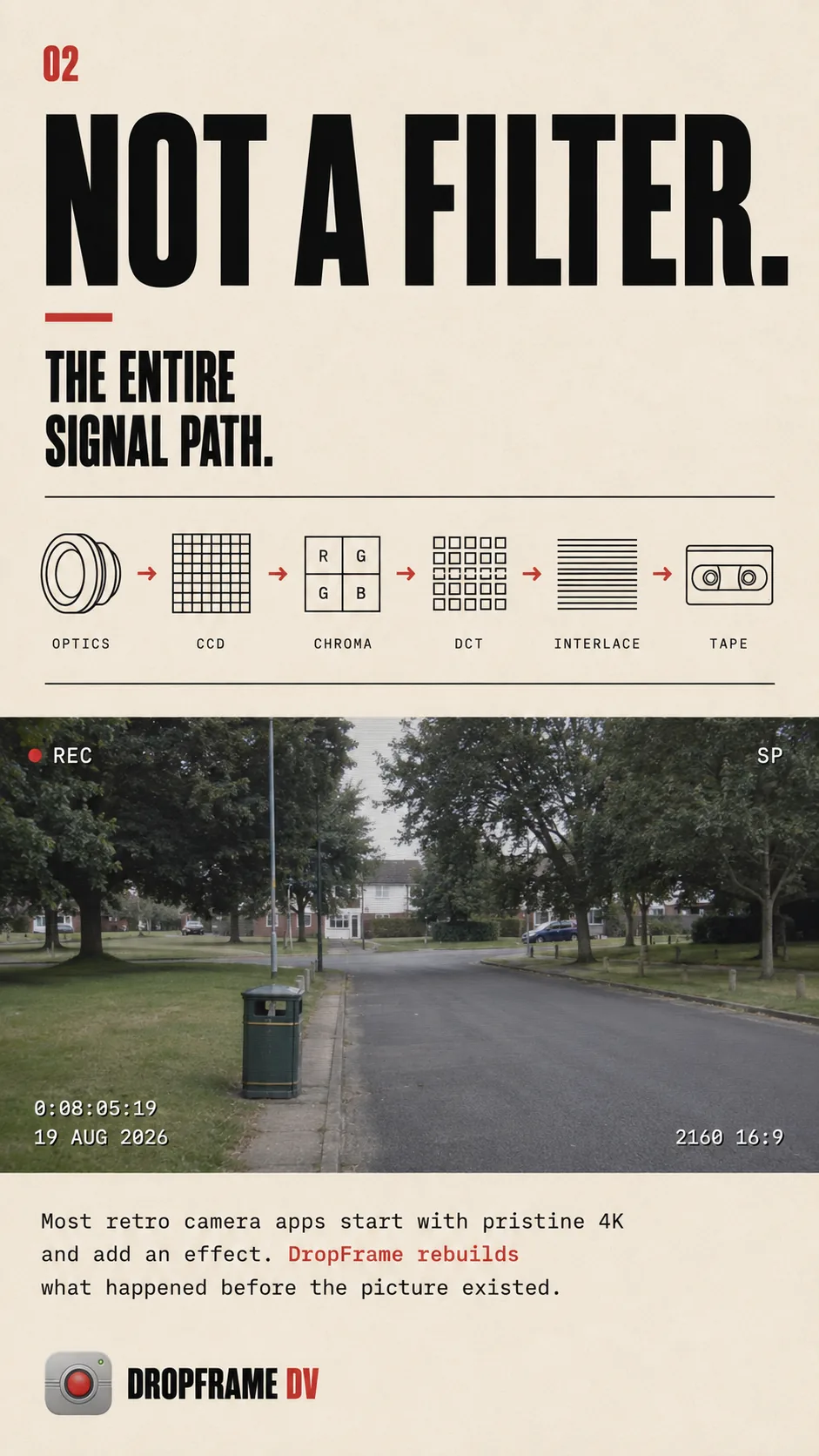
Not a filter. Dropframe DV rebuilds the entire signal path of a 1990s camcorder — optics, CCD sensor, tape codec and all — and runs your camera through it in real time.
Every frame here came out of the app itself — no mock-ups, no retouching. Swipe through.
Why it looks right
Most retro apps put a filter over a pristine 4K image
Dropframe does what the camera did, in the order the camera did it. That order is the whole thing: sharpening after colour subsampling looks wrong, and subsampling after compression looks wrong. Get the sequence right and it stops reading as an effect.
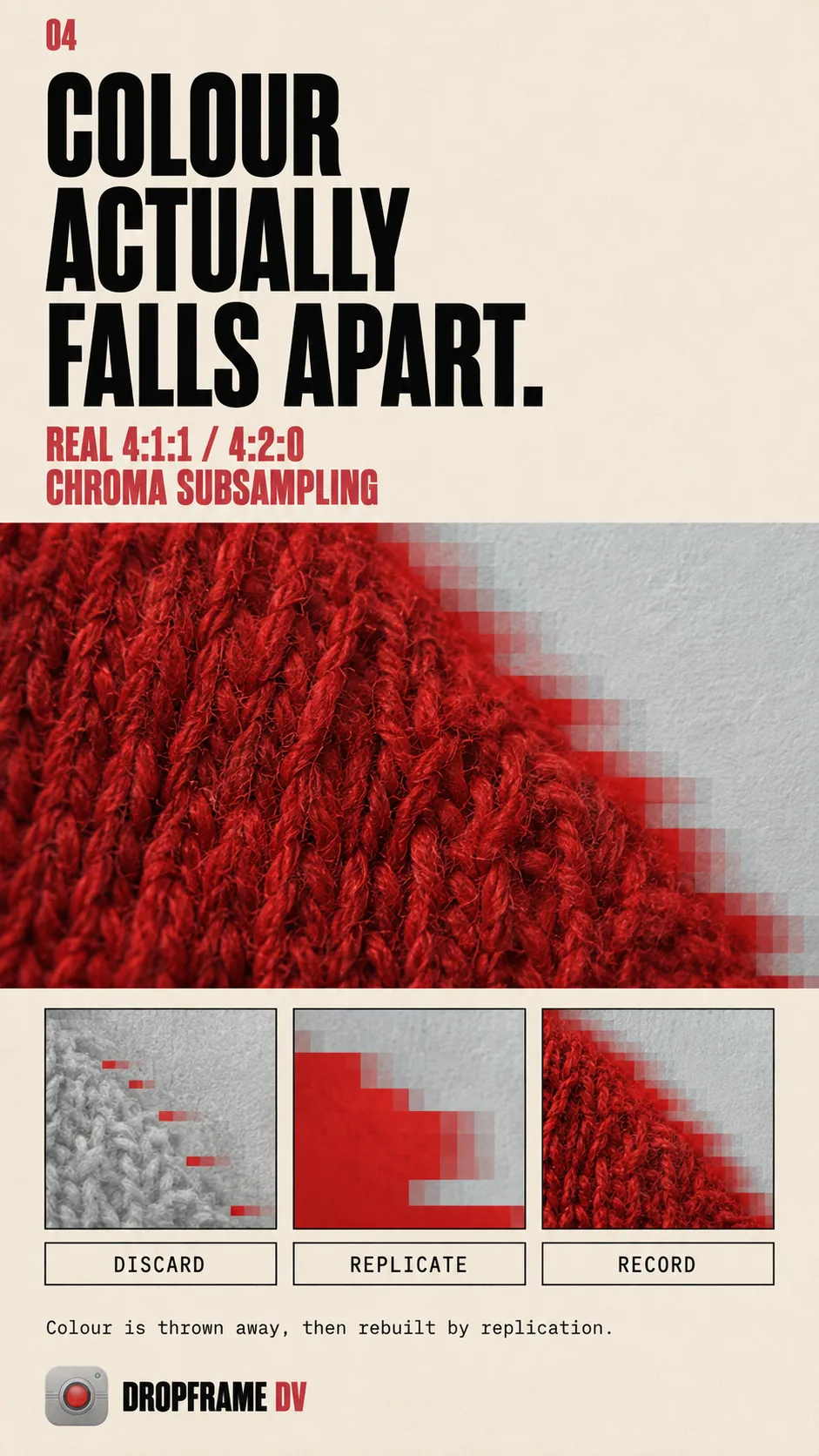
Real chroma loss
Colour is thrown away at 4:1:1 or 4:2:0 and rebuilt by replication, not interpolation. That is what makes a red jumper's edge staircase away from the person wearing it. It is the most recognisable DV artifact and nothing else on the store reproduces it.
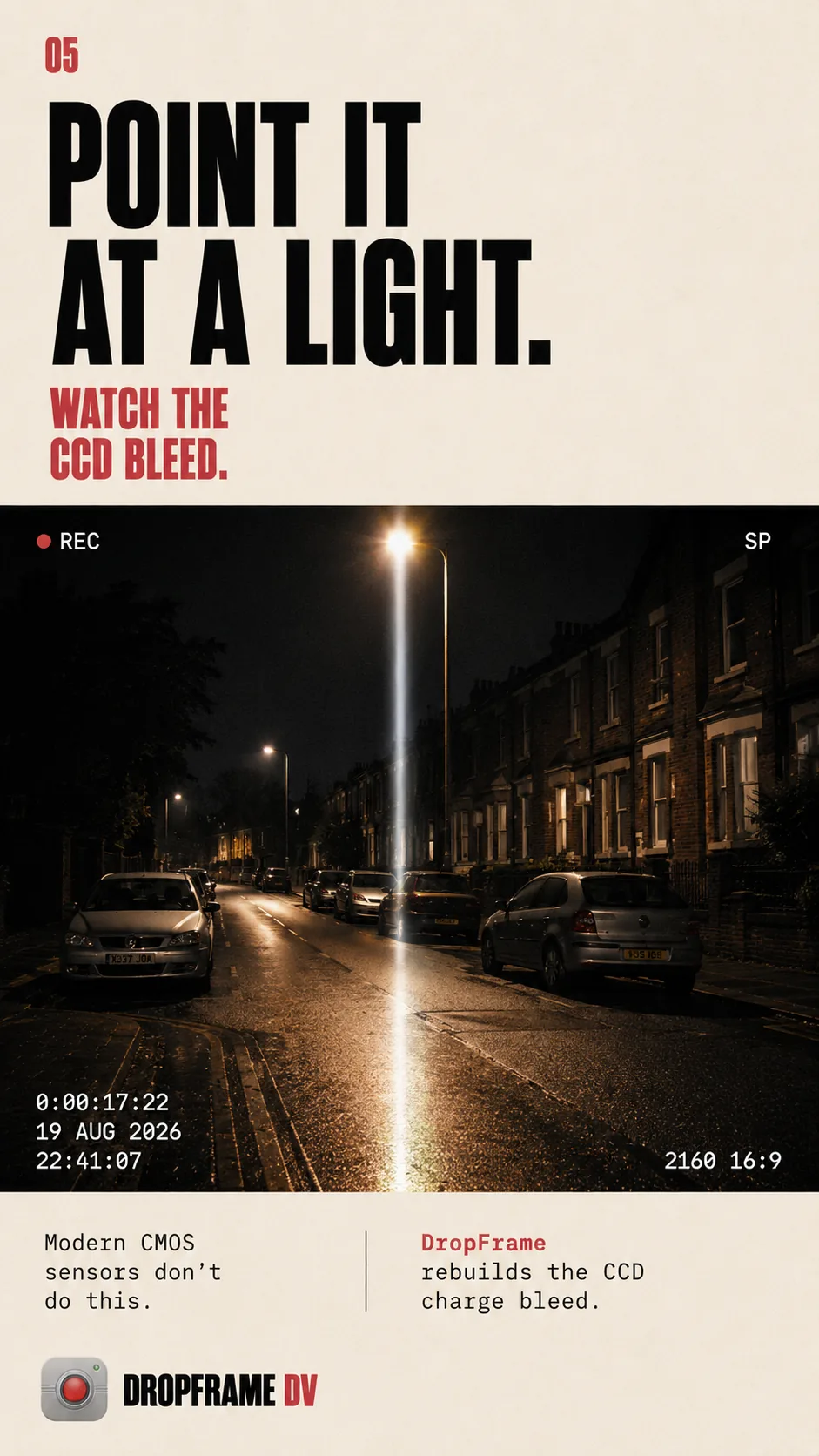
CCD vertical smear
Point a camcorder at a streetlight and a column of light runs the full height of the frame. Your iPhone's sensor physically cannot do this, so Dropframe simulates the charge bleed directly.
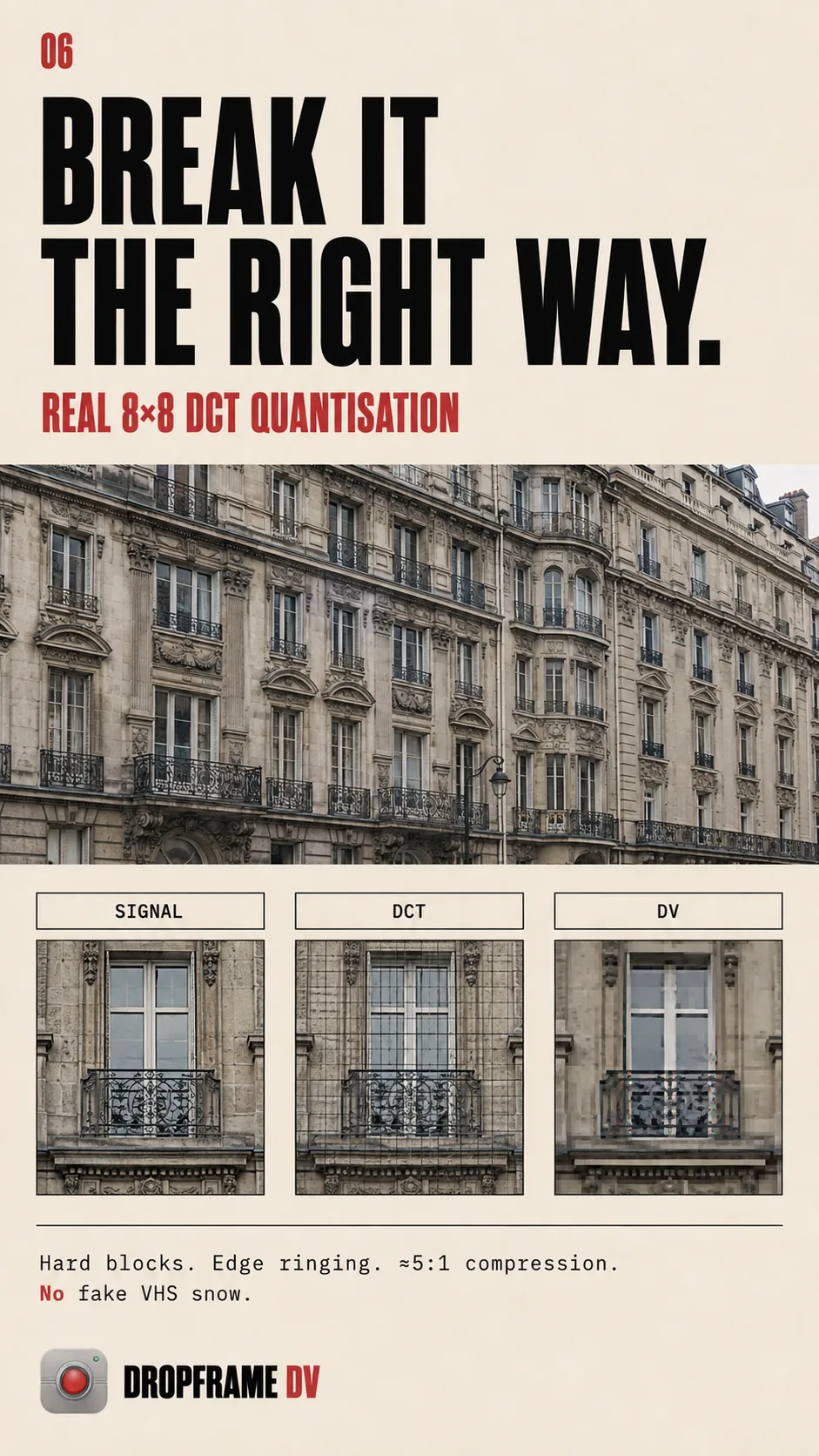
The actual codec
DV was intra-frame 8×8 DCT at roughly 5:1. Dropframe runs a real DCT quantisation pass, so footage breaks into hard blocks and rings around edges — the way digital tape failed. No snow, no tracking bars. Those belong to VHS.
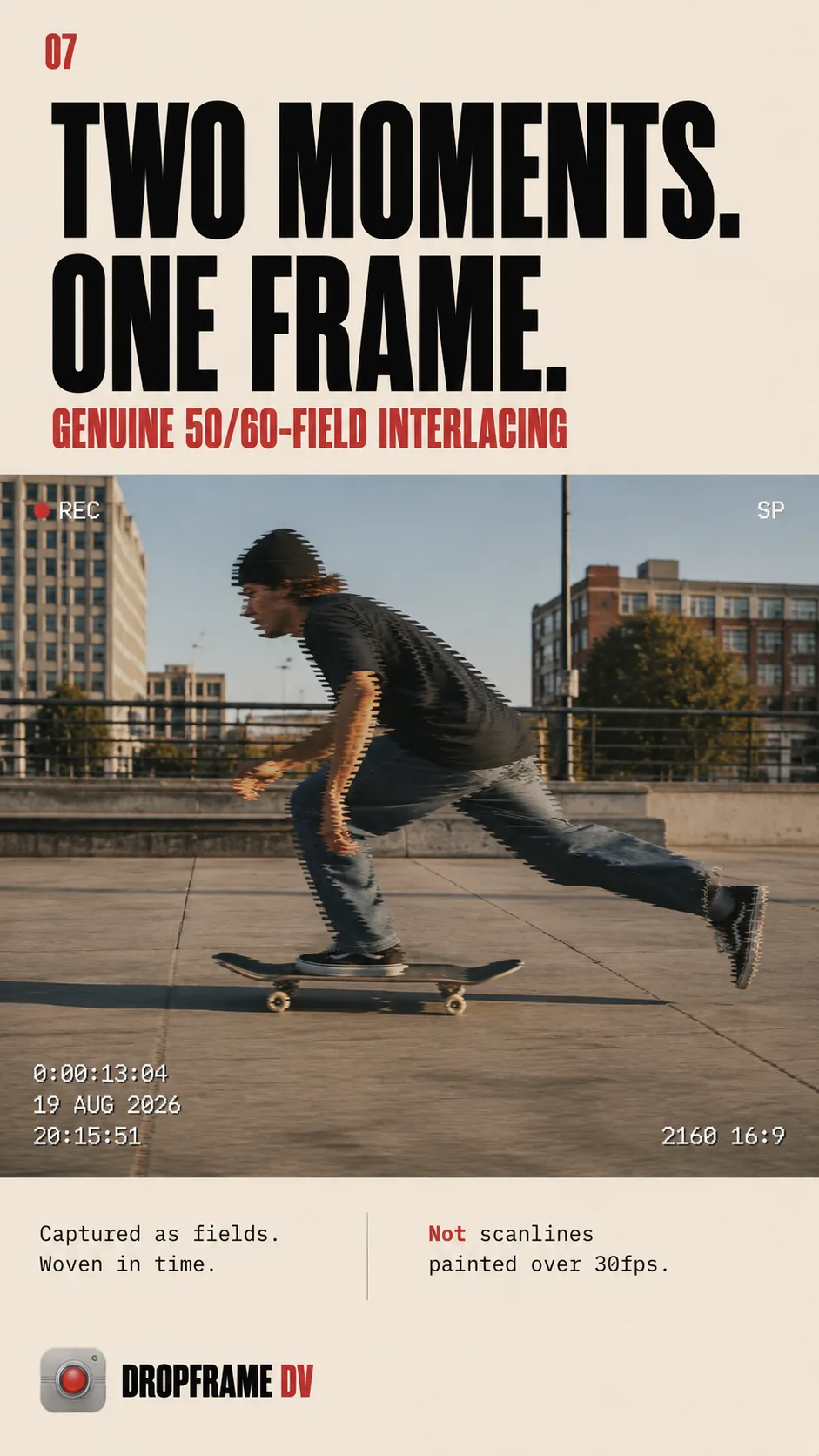
Genuine interlacing
Dropframe captures at 50 or 60 fields per second and weaves two moments in time into every frame. That temporal density is why camcorder footage feels immediate rather than cinematic. Apps that draw scanlines over 30fps get the texture and miss the motion.
The microphone too
Band-limited, mono-spread, hissing, and pumping hard through automatic gain control with no manual override. Audio is half of why old footage feels old, and nobody else bothers.
Cameras
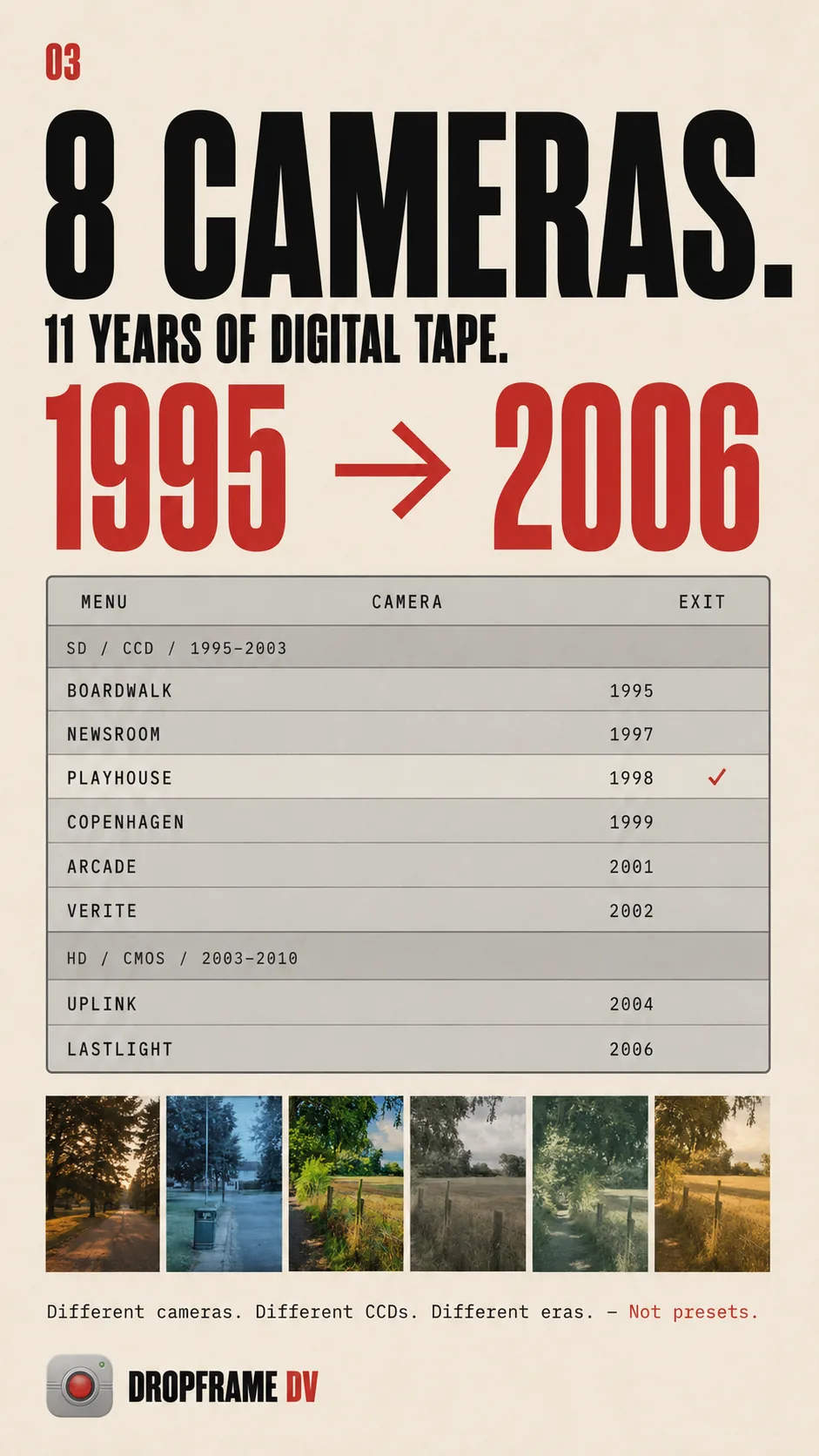
Eight bodies across four eras
Each one deconstructed into what actually differs: colour bias, dynamic range, motion cadence, optical character and digital artifacts. The names describe the work made on them, not the model numbers.
MENUCAMERAEXIT
SD / CCD / 1995–2001
BOARDWALK19951/3″ 3CCD • 520 Lines • Hard Contrast
VERITE20021/3″ 3CCD • 530 Lines • Cine Gamma • 24p
HD / 2004–2006
UPLINK20041/3″ 3CCD • 1080i • Cool Zeiss • 60i
LASTLIGHT20061/3″ 3CCD • 1080p • Cine Curve • 24p
Controls
Built for filmmakers. Easy for everyone.
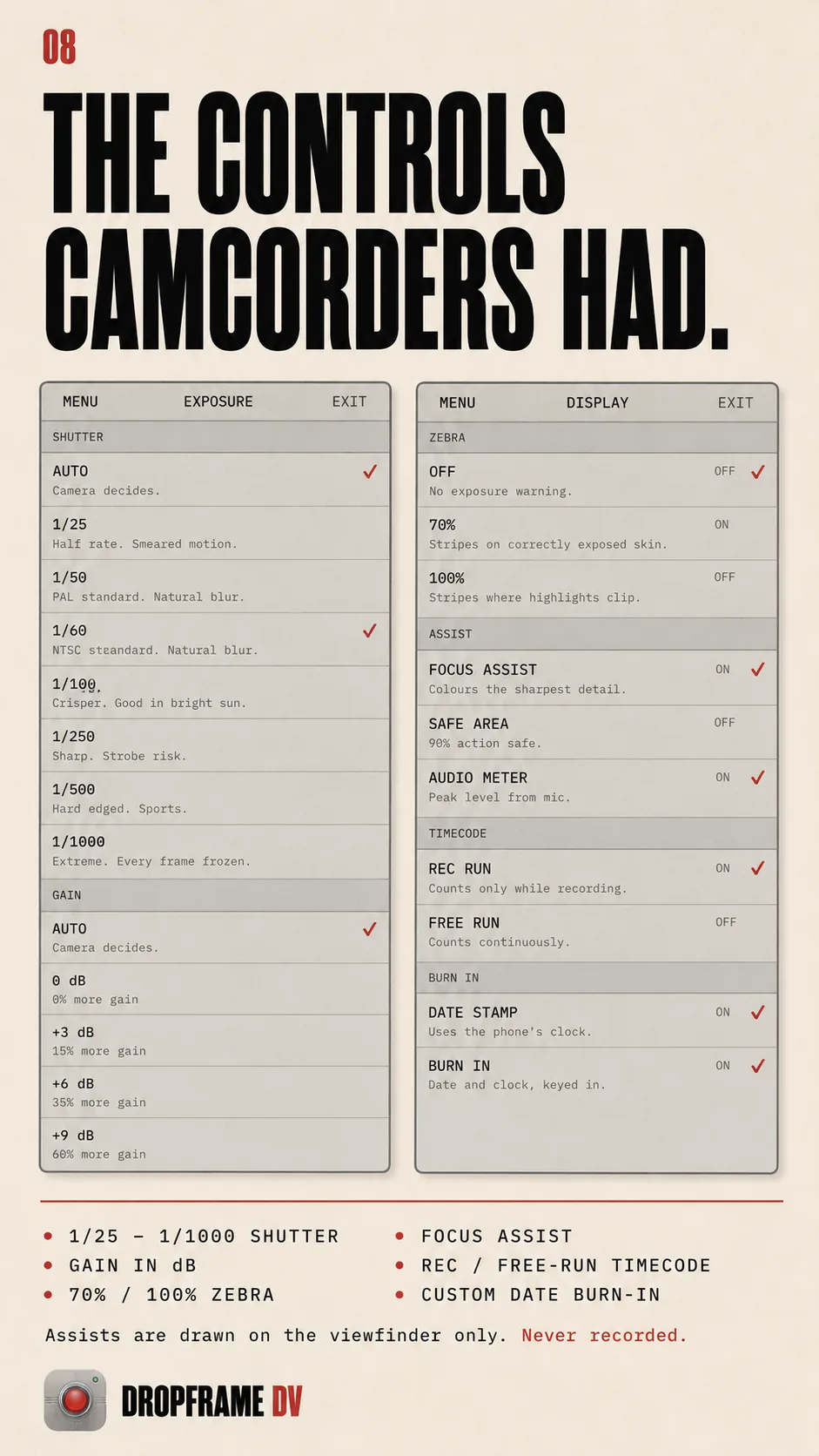
Every control existed on a real tape-era camcorder. Shutter and gain rather than ISO and aperture, because that is what the dial said. The capability is professional; the vocabulary is period.
Shutter
1/25 to 1/1000. The biggest lever on the look: 1/50 gives that liquid handheld feel, 1/500 turns the same pan strobed and harsh.
Gain in dB
0 to +18. Applied before the noise model, so pushing it lifts the shadows and drags chunky grain up with them, exactly as tape did.
Assists
Zebra at 70% and 100%, focus assist, safe-area guides and a peak audio meter. Drawn on the viewfinder only — never recorded to the file.
Timecode
Rec-run counts only while recording, like tape. Free-run counts against the clock. Set any start value you like.
Date stamp
Burn in any date without touching your phone's clock. Shoot today, stamp it 24 DEC 1999.
Framing
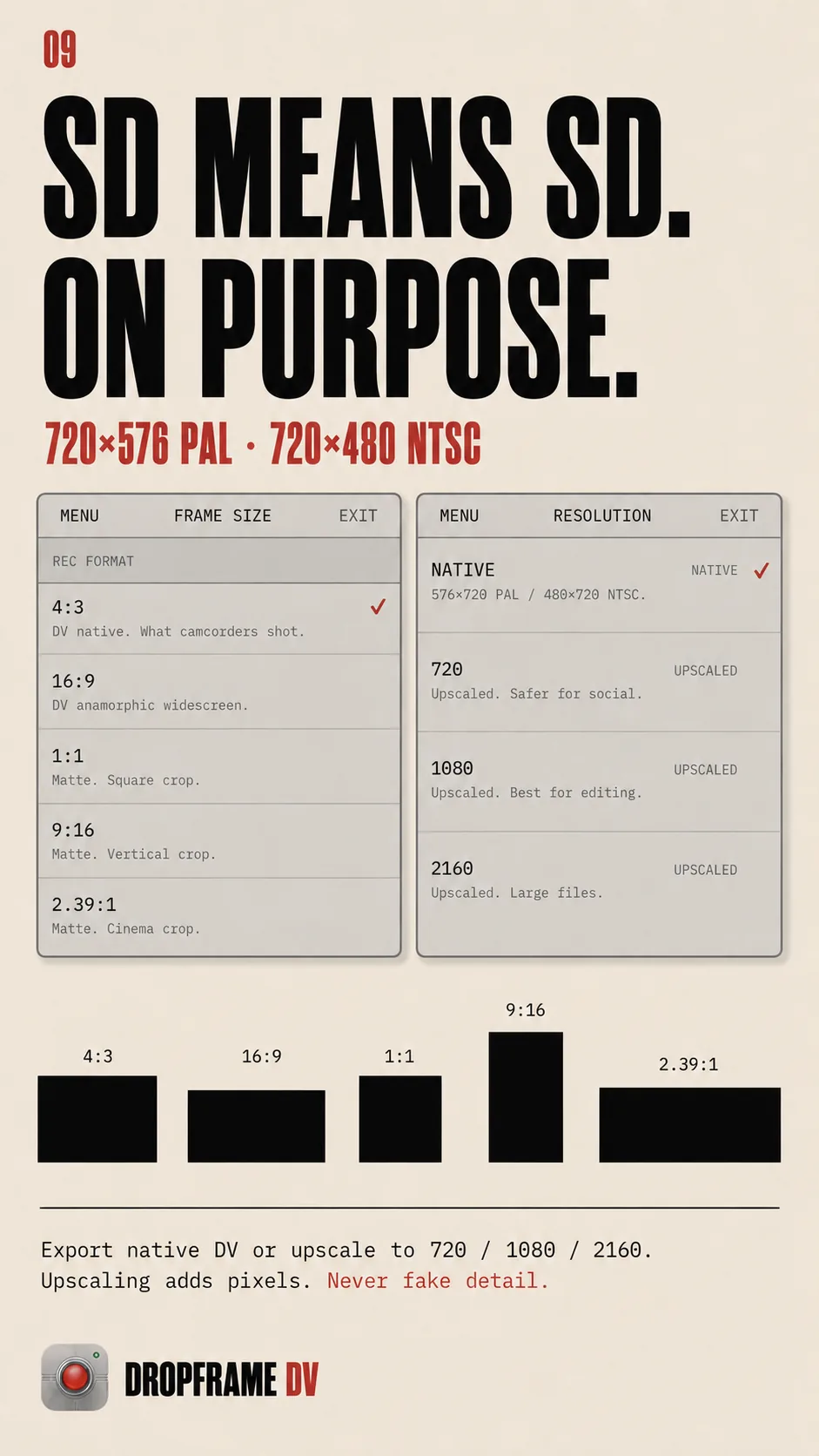
4:3 and 16:9 as DV recorded them, plus 1:1, 9:16 and 2.39:1 mattes. Export at native DV or upscaled to 720, 1080 or 2160.
Why I made this
The format that made filmmaking possible for me
I fell in love with cinema as a teenager in the nineties and knew I wanted to make films. The cost made it impossible. Celluloid stock and processing were simply out of reach.
Then MiniDV arrived, and with it a camera I could actually afford. Filmmakers I admired were already there: Lars von Trier, Danny Boyle, David Lynch, Richard Linklater. Dancer in the Dark, 28 Days Later, Inland Empire, Tape. None of them apologised for the format — they used it deliberately, for realism and for speed.
Mobility
Small camcorders meant shooting in tight spaces and public places without a crew-sized footprint. You could be discreet, and you could move.
Accessibility
No film stock, no processing bills. It democratised filmmaking by removing the one barrier that had kept people like me out.
Aesthetic intent
The pixelation, the low-light grain, the raw texture — none of it was a compromise. It was the point. It read as modern reality, or as psychological decay, depending on who was holding the camera.
Modern cameras are extraordinary. Phones, DSLRs, camcorders — all pristine, all ultra HD, all effectively perfect. But I miss how those old cameras saw. The rawness, the limits, the way the image fell apart at the edges and told you something by doing it. And the cameras themselves are getting harder to find every year.
Dropframe DV puts them back in your hand: a modern capture device, looking through old eyes.
— Connor Clements
Price
Buy it once. Own it.
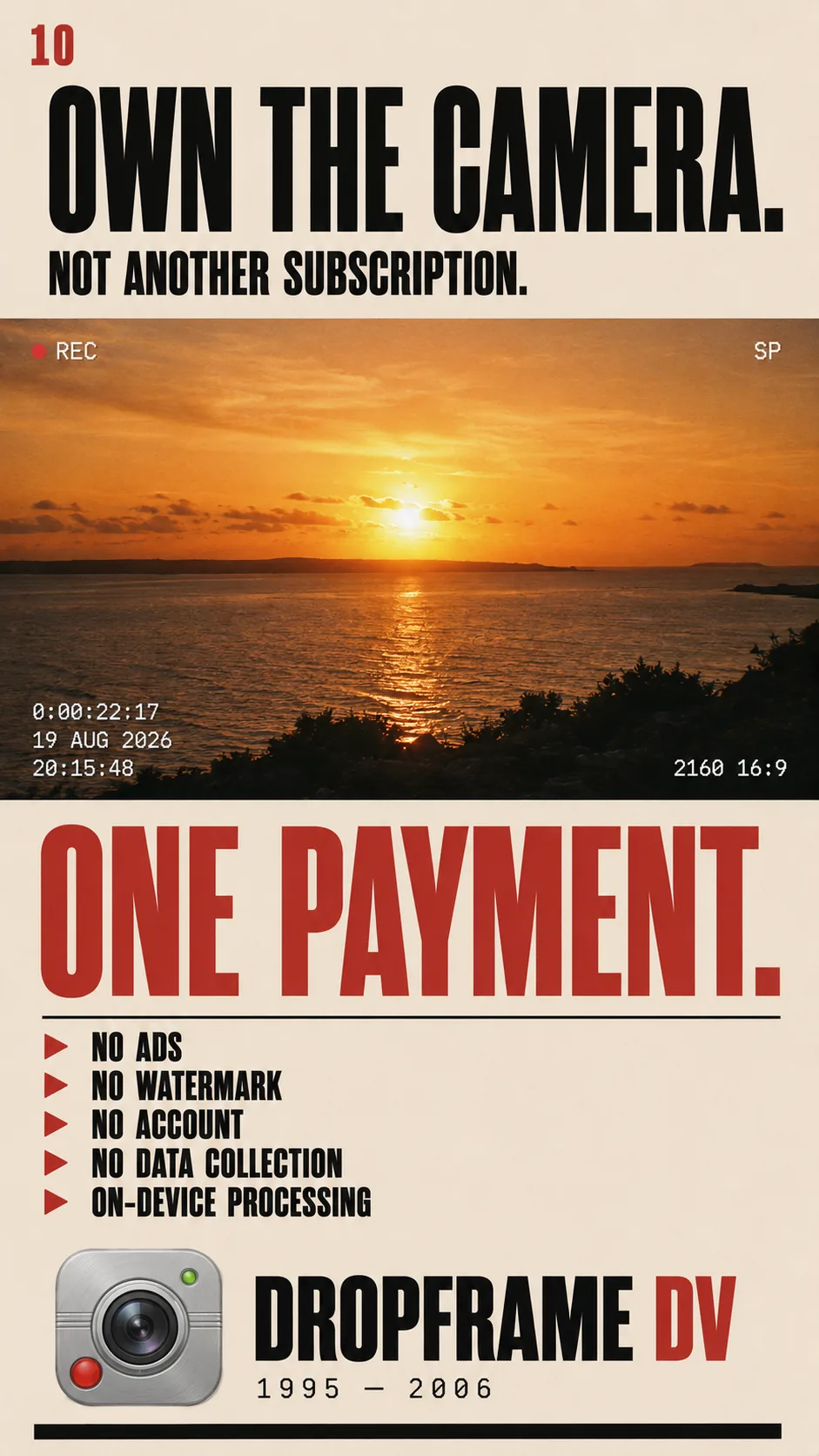
No weekly billing, no ads, no watermark, no account, no data collection. Everything runs on your device. Universal purchase across iPhone and iPad.
The iPhone app is acquisition — a camcorder you carry. The Mac app is conversion: drop in anything you already shot on any camera, and it comes out as genuine DV. Motion is synthesised to the real field rate, so 24p becomes true 50i rather than scanlines painted over 24 frames.
ProRes out, a .cube LUT for every camera, batch queue. The same eight cameras from the same shared code, so a shot looks identical whichever app made it.